At-Home Clear Aligners Without a Dentist: Risks to Know Before You Order Online

Clear aligners ordered online with no dental exam or follow-up: risks to teeth and gums, warning signs and 8 questions to ask before you choose.
An advert promises a straight smile in a few months, from your living room, for a fraction of a dental practice’s price. No appointments: an impression you take yourself, and aligners delivered by post. The idea is appealing, but moving a tooth means applying force to its root and to the bone and gum around it. Here is what changes when no dentist examines you or follows your treatment, and how to choose wisely.
1. What “At-Home Aligners” Really Covers
The phrase actually covers three very different ways of being treated. Only the first truly dispenses with a dentist, and it is the one this guide warns against. The table is deliberately general: offers vary from one provider to another.
| Online order without a dentist | Remote follow-up supervised by a dentist | Treatment followed at the practice | |
|---|---|---|---|
| Clinical exam and X-rays before starting | No: questionnaire and photos | Yes, by a dentist | Yes, by your dentist |
| Who approves the treatment plan | Not always a dentist who has examined you | A dentist who has examined you | Your dentist |
| Impression or scan | Self-taken impression kit, or a scan without a practitioner | Scan taken by a professional | Intra-oral scan by the dentist |
| Check-ups during treatment | Photos sent by the patient, no examination | Photos and teleconsultation, appointments if needed | Regular appointments at the practice |
| An aligner that no longer fits, a complication | Remote reply, or referral to a dentist of your choice | Handled by the supervising dentist | Handled by your dentist |
| Retainer at the end of treatment | Sometimes sold as an extra, without follow-up | Planned by the dentist | Planned by the dentist |
2. The Seven Risks of Treatment Without a Dentist
An undetected disease
Before moving teeth, you need to be sure the teeth, gums and bone are healthy. A deep cavity, an infection, periodontitis or an impacted tooth cannot be seen in a selfie. Applying orthodontic force to teeth whose bone support is weakened can worsen attachment loss and tooth mobility.
A case that cannot be treated with aligners alone
Aligners have indications and limits: major rotations, severe open bites, jaw discrepancies, some cases involving extractions. A questionnaire cannot tell a simple case from a complex one; an examination, X-rays and a bite analysis can. Without them, treatment may fail, or end in a straight smile with a worse bite.
An inaccurate impression or scan
Aligners are made from the impression: an error on the arch is carried into every aligner in the series. An untrained impression taken at home is more exposed to bubbles, distortion and poorly reproduced teeth than an intra-oral scan taken by a professional.
No check on what the teeth are actually doing
Teeth do not always follow the plan exactly. Without check-ups, nobody notices a tooth that “drops out” of its aligner, or decides to add an attachment, redo a series or pause. Errors build up from one aligner to the next, and the next series is made for a position the teeth have not reached.
Side effects that go unnoticed
Even when well managed, orthodontic treatment can cause sensitivity, gum recession, shortening of the roots (root resorption), a change in the bite or jaw joint pain. A dentist who follows you spots them early and adjusts the treatment. Alone, you find out once they have set in.
A forgotten retainer, and therefore relapse
Once aligned, teeth tend to drift back towards their original position. The retainer (bonded wire or retainer tray) has to be chosen, fitted and monitored. When it is sold as an extra with no follow-up, relapse is only a matter of time.
Nobody to answer when something goes wrong
If something goes wrong, who is responsible? The provider may be on the other side of the world, and your local dentist did not design the plan: some hesitate to continue a treatment they did not plan. The patient is left with a mouth mid-treatment and a bill to rescue it.
3. Why the Low Price Is Misleading
The advertised price rarely includes what makes a real treatment: the examination, X-rays, check-ups, refinements and the retainer. When the result is not what you expected, you pay again: an assessment at a dentist, sometimes a complete corrective treatment. A more expensive but complete treatment can end up costing less than a cheap one that has to be redone.
4. Warning Signs During Treatment
Wherever you are being treated, see a dentist promptly if:
- Your gums bleed repeatedly, swell or recede
- A tooth becomes loose, very sensitive or painful beyond the first two or three days of a new aligner
- An aligner no longer seats fully despite several days of wear
- The way you bite has changed, or your teeth no longer meet as before
- Pain or clicking appears in your jaw, or you wake with headaches
- White spots or a cavity appear under the aligners
- Swelling, an abscess or a persistent bad taste appears in your mouth
Never force an aligner into place, and never file your teeth yourself.
5. Eight Questions to Ask Before Choosing a Provider
- Will a dentist or orthodontist examine me in person, with X-rays, before any treatment?
- Who designed my treatment plan, and can I know their name and qualification?
- Will I see a simulation of my final result before I start?
- How is the impression or scan taken, and by whom?
- Who follows me during treatment, how often and how?
- What happens if an aligner breaks, stops fitting or the teeth do not move as planned?
- Are the retainer and refinement aligners included in the price?
- Are the materials certified, and who can I turn to near me if there is a complication?
6. Remote Follow-Up Is Not the Absence of a Dentist
Remote follow-up (standardised photos, teleconsultation) is real progress when a dentist has examined the patient, approved the plan and remains responsible for it. The problem is not the digital tool; it is removing the dentist.
The Infinity Aligner pathway relies on a certified dentist in the network: consultation, intra-oral scan and photographs with no physical impressions, a 3D simulation of your final smile to approve before manufacturing, then regular check-ups with your dentist. For patients who live outside Tunisia, a hybrid protocol lets you receive the complete kit during one stay in Tunis, with remote follow-up by teleconsultation.
Frequently Asked Questions
Are aligners ordered online dangerous?
Not by nature: the risk comes from the lack of examination and follow-up. The same aligners can be safe when a dentist prescribes and monitors them, and risky when used alone.
Is a fully remote treatment possible?
Some pathways combine an initial examination with remote follow-up supervised by a dentist. A treatment with no clinical examination at all is not recommended: you do not move teeth without knowing what condition they are in.
I have already started treatment online: what should I do?
See a dentist for an assessment (examination and X-rays), bringing your treatment plan and your aligners. They will judge whether the treatment can continue, be corrected or needs to be restarted. Do not stop or resume treatment on your own.
Can a dentist take over a treatment started elsewhere?
Often yes, after a new assessment. Some prefer to draw up their own plan: taking over depends on the condition of the teeth and the equipment available.
In Summary
A good aligner treatment rests on four things: an examination before you start, a plan approved by a dentist you can identify, follow-up during treatment and a planned retainer. If one is missing, the low price is only apparent. To find out whether aligners suit your case, book an appointment with an Infinity Aligner certified dentist: the examination, scan and 3D simulation will tell you exactly what is possible.
Infinity Aligner
Clinical & editorial team
More articles

How to Choose Clear Aligners in Tunisia

Clear Aligners vs Braces: Complete Comparison

How Much Do Clear Aligners Cost in Tunisia?
How Long Does Clear Aligner Treatment Take?
How to Clean and Care for Your Clear Aligners Daily

Clear Aligners for Teenagers: What Parents Need to Know
Gap Teeth & Diastema: Can Clear Aligners Fix Them?
Can You Play Sports with Clear Aligners?

3D Smile Simulation: How It Works and What to Expect

Orthodontic Relapse: Why Teeth Move After Treatment
Intraoral Scanner vs Traditional Impressions: What's the Difference?

Clear Aligners for Adults: Is It Ever Too Late?
Wisdom Teeth and Clear Aligners: Are They Compatible?

Clear Aligners: A Versatile Therapeutic Approach in Orthodontics

Orthodontics and Periodontal Health: What Every Patient Needs to Know
The Technology Behind Clear Aligners: From Design to Tray

How to Prepare for Your Orthodontic Consultation: 10 Questions to Ask
Bruxism and Clear Aligners: Can You Correct and Protect at the Same Time?

Class II Malocclusion and Clear Aligners: What Treatment Options Exist?
Clear Aligners and Dental Implants: Protocol, Timing and Clinical Cases

Digital Workflow and Aligner Biomechanics: The Advanced Practitioner Protocol
The Limits of Clear Aligners: Identifying Complex Cases Beyond Their Reach
Aligner Manufacturing: Thermoforming, 3D Printing and Polymer Science
Invisible Orthodontics in 2030: Predictive AI, Direct Printing and Active Materials

Smile Without Borders: The Price of Aligners Between Tunisia, Europe and Canada
Attachments in Invisible Orthodontics: The Silent Levers of Biomechanics

The Smile Beyond the Mirror: The Profound Impact of Dental Alignment on Psychological Well-being
Tunisia: The New Eldorado of Digital Dentistry and Medical Tourism
Post-Orthodontic Retention: The Forgotten Step That Decides Everything
What You Can (and Cannot) Eat With Clear Aligners
Teeth Whitening and Clear Aligners: Can You Treat and Whiten at the Same Time?
TMJ and Clear Aligners: How Invisible Orthodontics Acts on Jaw Pain
The Different Types of Dental Retainer: A Complete Guide After Orthodontic Treatment
The hidden dangers of metal braces: what patients need to know
Root resorption: the silent risk of poorly managed orthodontic treatments

Orthodontics and cavities: how metal braces compromise dental hygiene

Orthodontic relapse: why teeth return to their original position
Braces and chronic pain: the underestimated impact on daily quality of life
Intraoral scanner vs conventional impressions: dimensional analysis and clinical implications
CAD/CAM digital workflow in orthodontics: from intraoral scanning to aligner fabrication
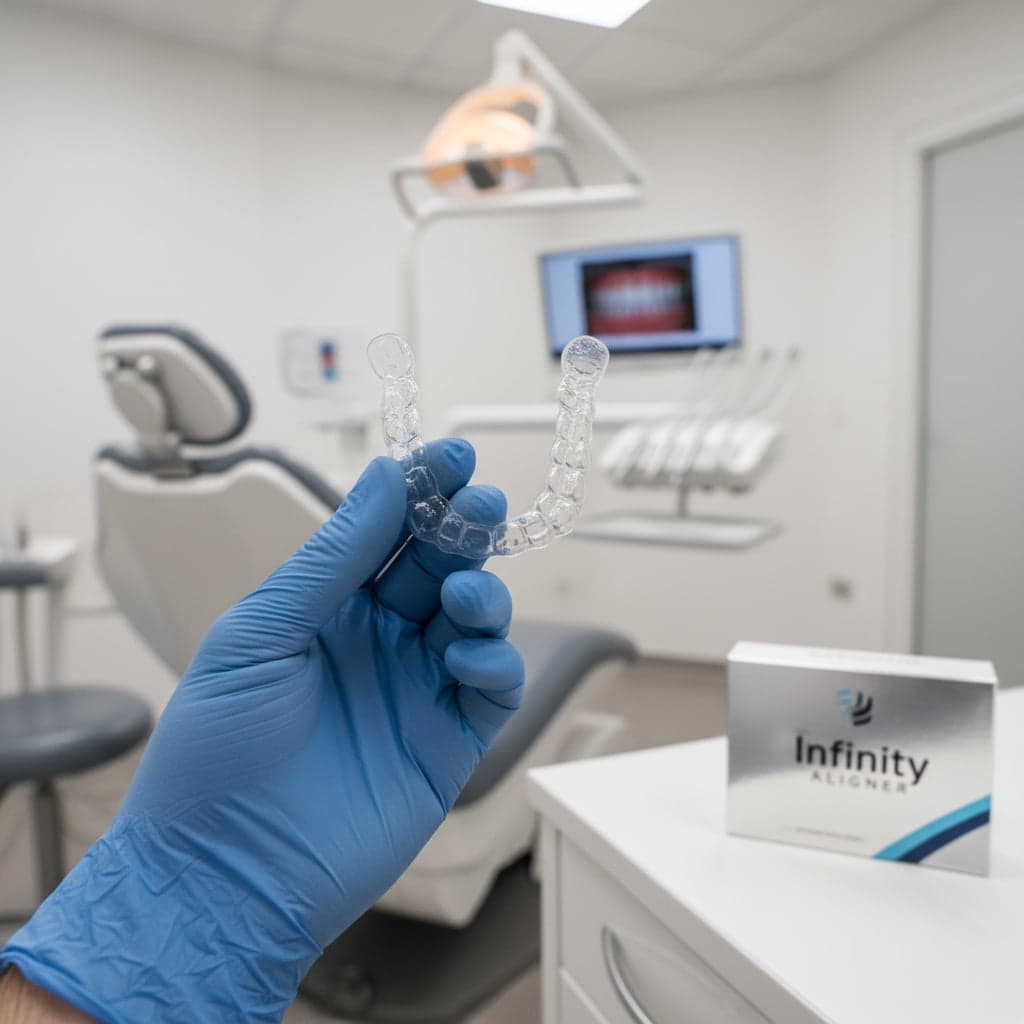
Deformation, shrinkage and cumulative errors: why the conventional impression chain compromises aligner precision
Intraoral Scanners 2025: Complete Technical and Metrological Comparison
Why Choose Infinity Aligner? The Complete Guide for Dental Practitioners
Composite Selection for Aligner Attachments: Mechanical Analysis and Clinical Protocol
TMJ and Malocclusion: Differential Diagnosis and Clinical Approach for the Practitioner
Travelling with Clear Aligners: The Complete Guide for Stress-Free Trips

The First Month with Aligners: What to Expect Week by Week
Pre-Prosthetic Orthodontics: Preparing the Site Before Implants or Veneers
How to Present Aligners to a Hesitant Patient — A Consultation Script
Anterior Open Bite and Aligners: Protocol, Intrusion and Relapse Risk
Posterior & Anterior Crossbite: Diagnosis and Correction with Clear Aligners
Tobacco, Cigarettes and Clear Aligners: Everything You Need to Know
Invisalign vs Infinity Aligner: Complete Price Comparison in Tunisia (2026)
What Happens If You Don't Wear Your Aligners 22 Hours a Day?
Myths and Misconceptions About Clear Aligners: What Patients and Dentists Get Wrong
Sleep Apnea and Orthodontics: The Dentist's Role in Screening and Management

Clear Aligners Before a Wedding: How Many Months Should You Plan?

Ramadan and Clear Aligners: A Guide to Wearing Them While Fasting
Consult a certified dentist
Our 200+ certified partners in Tunis, Sfax, Sousse and the francophone zone welcome you.
Book a consultation