What Happens If You Don't Wear Your Aligners 22 Hours a Day?
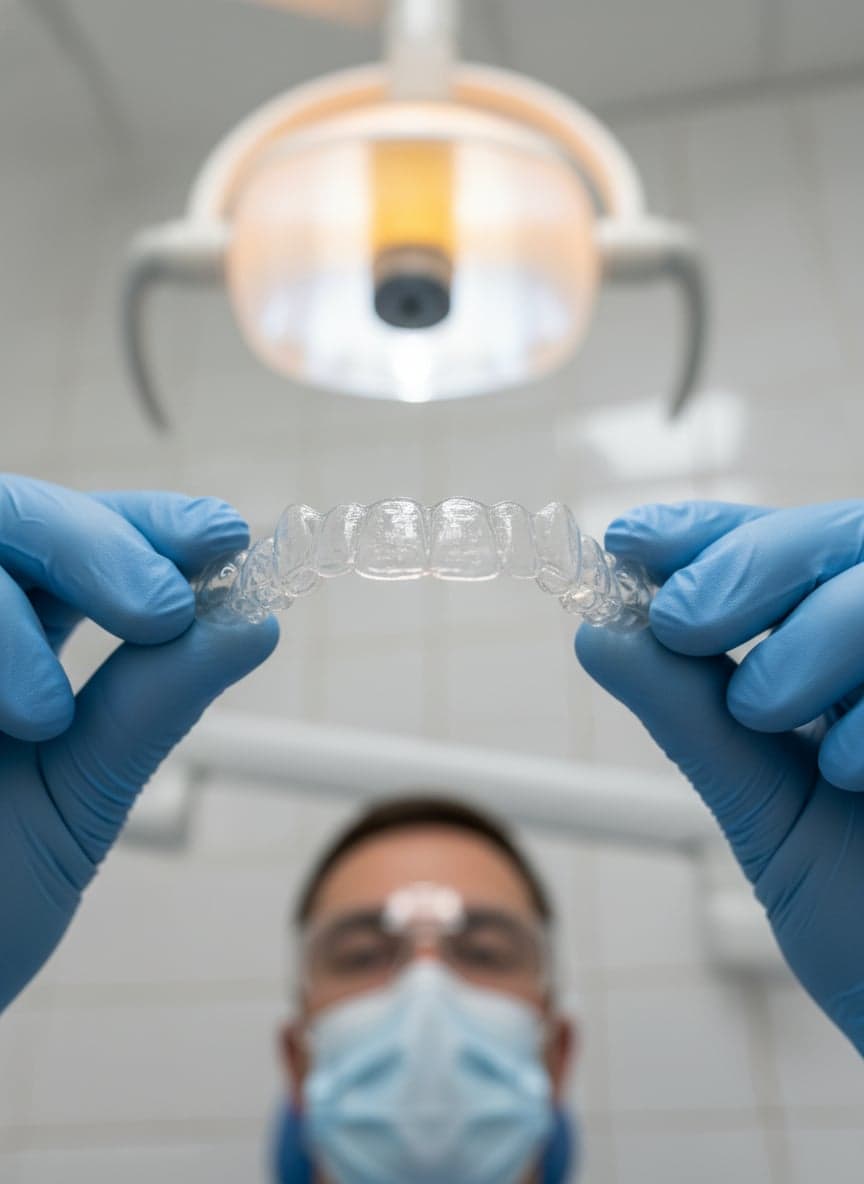
Taken your aligners out too often, skipped an evening, only worn them 16 hours? Here is exactly what happens to your teeth, your treatment timeline, and how to catch up after a bad week.
The 20-to-22-hour daily wear rule comes up in every consultation, on every instruction sheet, in every reminder your dentist sends. It can sound arbitrary — after all, a few missing hours here and there, how bad can it really be? The answer is: quite a bit. This guide explains exactly why, with numbers, the underlying biology, and concrete solutions if you've already fallen behind.
Why 22 hours and not less?
A clear aligner moves your teeth through continuous, progressive pressure. Each tray is engineered to exert a precise force — typically between 0.5 and 1.5 newtons per tooth — for a duration long enough for the alveolar bone to remodel around the root. This bone remodeling (resorption on one side, apposition on the other) is a slow biological process: it doesn't start instantly, and it doesn't hold instantly the moment pressure stops either.
The remaining 2 to 4 hours each day — the time the aligner is out for eating, brushing, and drinking anything other than water — are already built into the biomechanical calculation of your treatment plan. This isn't extra safety margin you can shave further. It's already the bare minimum.
| Daily wear time | Effect on tooth movement |
|---|---|
| 22h/day (recommended) | Sufficient continuous force — movement matches the 3D plan |
| 18-20h/day | Intermittent insufficient force — movement slows by 30-50% |
| 14-16h/day | Teeth have time to "relax" between wear periods — partial rebound |
| <12h/day ("nights only") | Near-zero movement — the tray only holds the position already achieved |
The biology: why a tooth "forgets" pressure
A tooth isn't anchored directly into bone — it's suspended in its socket by the periodontal ligament, a network of elastic fibers that absorbs and transmits force. When the aligner applies continuous pressure, the ligament compresses on one side and stretches on the other, triggering a cellular cascade: osteoclasts resorb bone on the compressed side (freeing up space) while osteoblasts lay down bone on the stretched side (filling the gap created by the movement).
This process has inertia. It takes roughly 4 to 6 hours of continuous pressure for the cellular cascade to kick in effectively. If you repeatedly remove the aligner before that threshold, the tooth partially drifts back toward its starting position between wear sessions — much like a rubber band that's stretched and released before it takes a permanent set. The periodontal ligament has a short-term elastic memory that directly works against fragmented, intermittent wear.
What actually happens depending on how much you skip
A one-off skip (one evening, one event)
Nothing serious. One evening without the aligner — a wedding, a work dinner — doesn't compromise treatment. Put the tray back in as soon as possible and continue as normal. The periodontal ligament absorbs this kind of isolated gap without any measurable effect on the overall timeline.
Irregular wear over several days (averaging 15-18h/day)
This is the most common scenario and the sneakiest one, because it causes no pain or visible warning sign. Movement continues, just slower. The concrete result: the next tray in the series starts to feel difficult to fully seat, because your teeth haven't reached the position the 3D plan expected. That's the first objective sign that wear time is falling short.
Extended non-wear (several days to several weeks)
Here the risk changes nature — it's no longer just slowdown, it's partial relapse: teeth begin drifting back toward their pre-treatment position. The longer the break, the more pronounced this drift, especially in the first few weeks after a movement (the phase where bone remodeling is least consolidated). Putting the aligner back in after several weeks off can then cause discomfort or even pain, because the tray no longer matches your teeth's current position exactly.
The 5 concrete consequences of chronic non-compliance
- Extended overall treatment duration — sometimes by several months
- Trays that no longer seat properly, forcing an unplanned refinement series
- A final result that differs from the 3D simulation approved at the start of treatment
- Risk of partial relapse requiring a longer, sometimes more uncomfortable catch-up phase
- Extra cost if additional refinement trays are needed (confirm with your dentist — often included in the package, but not always)
How to tell if you're already behind schedule
Three signs should alert you:
- The current tray no longer fully "clicks" onto every tooth, even after several days of wear
- A visible gap persists between the aligner's edge and the gumline on one or more teeth
- You feel unusual pressure or discomfort when moving to the next tray, when previous changeovers were painless
If any of these signs appear, do not move to the next tray as scheduled. Keep wearing the current tray a few extra days, strictly at 22h/day, until it seats fully again — then contact your dentist before proceeding.
How to catch up on missed wear time
| Situation | Recommended action |
|---|---|
| Isolated gap (1 evening) | Resume normal wear immediately, no further action needed |
| Irregular wear over 1-2 weeks | Stay on the current tray 3 to 5 extra days at strict 22h before moving on |
| Tray no longer seats fully | Go back to the previous tray that fit well, or contact your dentist for reassessment |
| More than 2 weeks off | Mandatory contact with your dentist before resuming — a new scan or refinement may be needed |
The one thing to absolutely avoid: forcing a tray that doesn't fully seat, hoping it will "settle into place on its own." A poorly seated tray exerts uncalculated forces on certain teeth, which can create unwanted movement rather than catch up the delay.
Practical strategies to actually hit 22 hours every day
- Only remove the aligner to eat and brush — not for a coffee or any non-clear drink except water
- Put the tray back in immediately after brushing, before even leaving the bathroom
- Always carry the storage case — an aligner set on a paper napkin at a restaurant gets lost or thrown away easily
- Set a reminder alarm if you tend to forget after a long meal
- If you smoke, be aware that removing the aligner for every cigarette can add up to several hours a day — covered in detail in our article on smoking and aligners
- For contact sports, wear a compatible mouthguard rather than routinely removing the aligner
How your dentist checks compliance
At every check-up, your dentist verifies how well the current tray fits your teeth (the "fit check"): a perfect fit confirms wear time is on track. An imperfect fit triggers a conversation about wear habits before adjusting the schedule. Some aligner systems also include a compliance indicator — a small colored dot on the tray that fades with wear, giving an objective read on actual wear time.
Conclusion
The 22-hour rule isn't an arbitrary guideline — it's the biological threshold below which the periodontal ligament doesn't have time to consolidate the tooth movement in progress. A few isolated gaps compromise nothing, but chronic slack — even moderate, around 16-18h/day — slows treatment, can require extra refinement trays, and delays your final smile. The good news: a delay caught early is easy to fix by simply staying longer on the current tray. The only real risk is ignoring the warning signs and forcing a tray that no longer matches where your teeth actually are.
Infinity Aligner
Clinical & editorial team
More articles

How to Choose Clear Aligners in Tunisia

Clear Aligners vs Braces: Complete Comparison

How Much Do Clear Aligners Cost in Tunisia?

How Long Does Clear Aligner Treatment Take?

How to Clean and Care for Your Clear Aligners Daily

Clear Aligners for Teenagers: What Parents Need to Know
Gap Teeth & Diastema: Can Clear Aligners Fix Them?

Can You Play Sports with Clear Aligners?

3D Smile Simulation: How It Works and What to Expect

Orthodontic Relapse: Why Teeth Move After Treatment

Intraoral Scanner vs Traditional Impressions: What's the Difference?

Clear Aligners for Adults: Is It Ever Too Late?

Wisdom Teeth and Clear Aligners: Are They Compatible?

Clear Aligners: A Versatile Therapeutic Approach in Orthodontics

Orthodontics and Periodontal Health: What Every Patient Needs to Know
The Technology Behind Clear Aligners: From Design to Tray

How to Prepare for Your Orthodontic Consultation: 10 Questions to Ask

Bruxism and Clear Aligners: Can You Correct and Protect at the Same Time?

Class II Malocclusion and Clear Aligners: What Treatment Options Exist?

Clear Aligners and Dental Implants: Protocol, Timing and Clinical Cases

Digital Workflow and Aligner Biomechanics: The Advanced Practitioner Protocol

The Limits of Clear Aligners: Identifying Complex Cases Beyond Their Reach
Aligner Manufacturing: Thermoforming, 3D Printing and Polymer Science
Invisible Orthodontics in 2030: Predictive AI, Direct Printing and Active Materials

Smile Without Borders: The Price of Aligners Between Tunisia, Europe and Canada

Attachments in Invisible Orthodontics: The Silent Levers of Biomechanics

The Smile Beyond the Mirror: The Profound Impact of Dental Alignment on Psychological Well-being

Tunisia: The New Eldorado of Digital Dentistry and Medical Tourism
Post-Orthodontic Retention: The Forgotten Step That Decides Everything
What You Can (and Cannot) Eat With Clear Aligners
Teeth Whitening and Clear Aligners: Can You Treat and Whiten at the Same Time?

TMJ and Clear Aligners: How Invisible Orthodontics Acts on Jaw Pain
The Different Types of Dental Retainer: A Complete Guide After Orthodontic Treatment
The hidden dangers of metal braces: what patients need to know
Root resorption: the silent risk of poorly managed orthodontic treatments

Orthodontics and cavities: how metal braces compromise dental hygiene

Orthodontic relapse: why teeth return to their original position

Braces and chronic pain: the underestimated impact on daily quality of life
Intraoral scanner vs conventional impressions: dimensional analysis and clinical implications
CAD/CAM digital workflow in orthodontics: from intraoral scanning to aligner fabrication
Deformation, shrinkage and cumulative errors: why the conventional impression chain compromises aligner precision
Intraoral Scanners 2025: Complete Technical and Metrological Comparison
Why Choose Infinity Aligner? The Complete Guide for Dental Practitioners
Composite Selection for Aligner Attachments: Mechanical Analysis and Clinical Protocol
TMJ and Malocclusion: Differential Diagnosis and Clinical Approach for the Practitioner
Travelling with Clear Aligners: The Complete Guide for Stress-Free Trips

The First Month with Aligners: What to Expect Week by Week
Pre-Prosthetic Orthodontics: Preparing the Site Before Implants or Veneers

How to Present Aligners to a Hesitant Patient — A Consultation Script

Anterior Open Bite and Aligners: Protocol, Intrusion and Relapse Risk
Posterior & Anterior Crossbite: Diagnosis and Correction with Clear Aligners

Tobacco, Cigarettes and Clear Aligners: Everything You Need to Know
Invisalign vs Infinity Aligner: Complete Price Comparison in Tunisia (2026)

Myths and Misconceptions About Clear Aligners: What Patients and Dentists Get Wrong

Sleep Apnea and Orthodontics: The Dentist's Role in Screening and Management

Clear Aligners Before a Wedding: How Many Months Should You Plan?

Ramadan and Clear Aligners: A Guide to Wearing Them While Fasting
Consult a certified dentist
Our 200+ certified partners in Tunis, Sfax, Sousse and the francophone zone welcome you.
Book a consultation