Tobacco, Cigarettes and Clear Aligners: Everything You Need to Know

Smoking during clear aligner treatment: what are the consequences for your aligners, your teeth and the effectiveness of your treatment? Complete guide for smokers.
It's one of the most common questions at the consultation: "I smoke — can I still use clear aligners?" The short answer is yes, smoking is not an absolute contraindication to orthodontic tray treatment. But the long answer — the one you deserve — is far more nuanced. Smoking during aligner treatment has direct consequences for your trays, your oral health, and the very effectiveness of your orthodontic movements. This guide gives you everything you need to make informed decisions.
1. What Happens When You Smoke with Aligners In
The first mistake — by far the most common — is smoking without removing your aligners. The thermoplastic polymer that makes up Infinity Aligner trays is perfectly transparent when manufactured. After just a few cigarettes, that plastic stains, yellows and loses its clarity under the combined effect of heat, nicotine and tar. This is not a myth or exaggeration: the porous polymer literally absorbs the pigments in smoke.
- Accelerated yellowing: aligners exposed to smoke discolour within days — far faster than they would from coffee or tea.
- Persistent odour: tobacco residues embed themselves in the plastic. No surface cleaning will fully eliminate that smell once it has set.
- Heat deformation: the hot smoke at the tip of a cigarette can reach temperatures sufficient to slightly warp the edges of aligners, compromising their precise fit on the teeth.
- Chemical residue build-up: tars and other substances form a film on the plastic that becomes a breeding ground for bacteria.
Practical conclusion: if you smoke, always remove your aligners before lighting a cigarette. This is non-negotiable.
2. The Impact on Your Teeth and Gums
Tobacco has well-documented effects on periodontal health — and wearing aligners amplifies some of these risks. Here is why.
- Plaque accumulation under the trays: smokers produce more tartar deposits. Aligners, worn 22 hours a day, create a near-sealed environment against the teeth. If tobacco residues or plaque remain trapped under the tray, they stay in prolonged contact with the enamel — promoting cavities and gum inflammation.
- Worsened dry mouth: tobacco reduces saliva production. Saliva plays a vital protective role by neutralising acids and naturally rinsing the teeth. Aligners themselves can slightly reduce salivary circulation. The combination increases cavity risk.
- Gingivitis and periodontitis: tobacco is a major risk factor for gum inflammation. By masking bleeding (nicotine's vasoconstrictive effect), it allows periodontal disease to progress silently — particularly problematic during orthodontic treatment, when gums must be in perfect health.
- Deeper tooth staining: tobacco stains on teeth are already difficult to remove. Worn under aligners continuously, they penetrate enamel even more deeply.
3. The Impact on Orthodontic Treatment Effectiveness
This is the aspect least known to smokers — and yet one of the most important. The tooth movements produced by aligners rely on a precise biological mechanism: bone remodelling. When an aligner applies gentle, continuous pressure to a tooth, bone cells (osteoclasts and osteoblasts) get to work — some resorbing bone on the pressure side, others depositing it on the opposite side. This mechanism is what allows a tooth to progressively move towards its new position.
Tobacco directly interferes with this process. Nicotine is a powerful vasoconstrictor: it reduces blood flow to the periodontal tissues. This reduced supply of oxygen and nutrients slows cellular activity, inhibits bone remodelling, and can therefore lengthen treatment duration. Orthodontic studies have shown that smokers present on average a slower biological response to orthodontic forces than non-smokers.
- Potentially longer treatment: movements planned in the 3D simulation may take longer to complete.
- Higher risk of refinements: if teeth do not follow the planned progression precisely, the practitioner will need to prescribe additional aligner series.
- Higher relapse risk: a periodontium weakened by tobacco retains teeth in position less effectively after treatment, increasing the risk of relapse even with retainers.
4. E-Cigarettes and Vaping: The Same Risks?
Many patients assume that e-cigarettes are a "neutral" alternative during treatment. This is partly false. While e-cigarettes do not contain tar, they produce hot vapour that is often loaded with nicotine — the two main causes of tobacco-related problems in the context of aligners.
- Heat: vapour produced by some e-cigarette models reaches temperatures high enough to slightly soften the aligner plastic with repeated exposure.
- Nicotine: same vasoconstrictive mechanism as traditional cigarettes — same effects on bone remodelling and periodontal health.
- Colourants and flavourings: some e-liquids contain dyes that can stain aligner plastic, especially red fruit, coffee or tobacco flavours.
- Dry mouth: hot vapour and propylene glycol (the base of e-liquids) contribute to drying out the oral mucosa, with the same consequences as traditional tobacco.
The rule remains identical: remove your aligners before vaping. Vaping is not an exception to the guidelines.
5. The 22-Hour Rule: How Smoking Complicates It
The effectiveness of aligners depends on a minimum of 22 hours of daily wear. Every hour "lost" — whether for eating, brushing, or removing trays to smoke — counts against this quota. For a regular smoker, the arithmetic quickly becomes problematic.
| Habit | Average duration | Hours/day out of aligners |
|---|---|---|
| Meals (×3/day) | 20–30 min each | 1h – 1h30 |
| Brushing + rinsing | 10 min × 3 | 30 min |
| 1 pack/day (20 cig.) | 5–7 min × 20 | 1h40 – 2h20 |
| 5 cigarettes/day | 5–7 min × 5 | 25 – 35 min |
| TOTAL (pack-a-day smoker) | — | 3h10 – 4h20 without aligners |
A patient who smokes a pack a day and takes normal mealtimes easily spends 3 to 4 hours without aligners — equating to 20–21 hours of actual wear, below the recommended threshold. This concretely translates into incomplete tooth movements at the end of each aligner, often requiring the practitioner to extend each stage or prescribe refinements.
6. Practical Tips for Smokers in Treatment
If quitting smoking is not feasible in the short term, here are the best practices to minimise damage and preserve the effectiveness of your treatment.
- Always remove your aligners before smoking — no exceptions.
- Rinse your mouth with water (or better: brush your teeth) before reinserting the trays.
- Clean your aligners morning and evening with cold water and a soft brush — never use toothpaste (abrasive) or hot water (causes warping).
- Reduce smoking to existing meal breaks: since aligners are already out during meals, smoke just before or just after eating and reinsert them just once.
- Drink more water: water intake partially counteracts the dry mouth caused by tobacco.
- Maintain regular periodontal check-ups: consult your dentist or periodontist alongside the orthodontic treatment to monitor your gum health.
- Be transparent with your practitioner: disclosing your tobacco use allows the practitioner to adapt the tray-change schedule and anticipate any necessary refinements.
7. Tobacco and Post-Treatment Retention
The retention phase — worn after active treatment is complete — is equally affected. Retainer trays, typically worn at night for life, yellow and lose clarity from tobacco in the same way. Furthermore, a periodontium weakened by years of smoking retains teeth in position less effectively: the risk of relapse is statistically higher in smokers, even with rigorous retention. This is a clinical reality your practitioner can explain at your initial assessment.
In Summary
Smoking during clear aligner treatment is not forbidden, but it requires extra discipline and a heightened awareness of the risks involved. Yellowing of the trays, dry mouth, gum inflammation, slowed bone remodelling, reduced effective wear time — the consequences are real and cumulative. The good news: by adopting the right practices (trays out during smoking, enhanced hygiene, regular periodontal monitoring), smokers can achieve quality orthodontic results. And for those considering quitting: the start of aligner treatment is often an excellent opportunity to make that new beginning.
Infinity Aligner
Clinical & editorial team
More articles

How to Choose Clear Aligners in Tunisia

Clear Aligners vs Braces: Complete Comparison

How Much Do Clear Aligners Cost in Tunisia?

How Long Does Clear Aligner Treatment Take?

How to Clean and Care for Your Clear Aligners Daily

Clear Aligners for Teenagers: What Parents Need to Know
Gap Teeth & Diastema: Can Clear Aligners Fix Them?

Can You Play Sports with Clear Aligners?

3D Smile Simulation: How It Works and What to Expect

Orthodontic Relapse: Why Teeth Move After Treatment

Intraoral Scanner vs Traditional Impressions: What's the Difference?

Clear Aligners for Adults: Is It Ever Too Late?

Wisdom Teeth and Clear Aligners: Are They Compatible?

Clear Aligners: A Versatile Therapeutic Approach in Orthodontics

Orthodontics and Periodontal Health: What Every Patient Needs to Know
The Technology Behind Clear Aligners: From Design to Tray

How to Prepare for Your Orthodontic Consultation: 10 Questions to Ask
Bruxism and Clear Aligners: Can You Correct and Protect at the Same Time?

Class II Malocclusion and Clear Aligners: What Treatment Options Exist?

Clear Aligners and Dental Implants: Protocol, Timing and Clinical Cases

Digital Workflow and Aligner Biomechanics: The Advanced Practitioner Protocol

The Limits of Clear Aligners: Identifying Complex Cases Beyond Their Reach
Aligner Manufacturing: Thermoforming, 3D Printing and Polymer Science
Invisible Orthodontics in 2030: Predictive AI, Direct Printing and Active Materials

Smile Without Borders: The Price of Aligners Between Tunisia, Europe and Canada

Attachments in Invisible Orthodontics: The Silent Levers of Biomechanics

The Smile Beyond the Mirror: The Profound Impact of Dental Alignment on Psychological Well-being

Tunisia: The New Eldorado of Digital Dentistry and Medical Tourism
Post-Orthodontic Retention: The Forgotten Step That Decides Everything
What You Can (and Cannot) Eat With Clear Aligners

Teeth Whitening and Clear Aligners: Can You Treat and Whiten at the Same Time?

TMJ and Clear Aligners: How Invisible Orthodontics Acts on Jaw Pain
The Different Types of Dental Retainer: A Complete Guide After Orthodontic Treatment
The hidden dangers of metal braces: what patients need to know
Root resorption: the silent risk of poorly managed orthodontic treatments

Orthodontics and cavities: how metal braces compromise dental hygiene

Orthodontic relapse: why teeth return to their original position

Braces and chronic pain: the underestimated impact on daily quality of life
Intraoral scanner vs conventional impressions: dimensional analysis and clinical implications
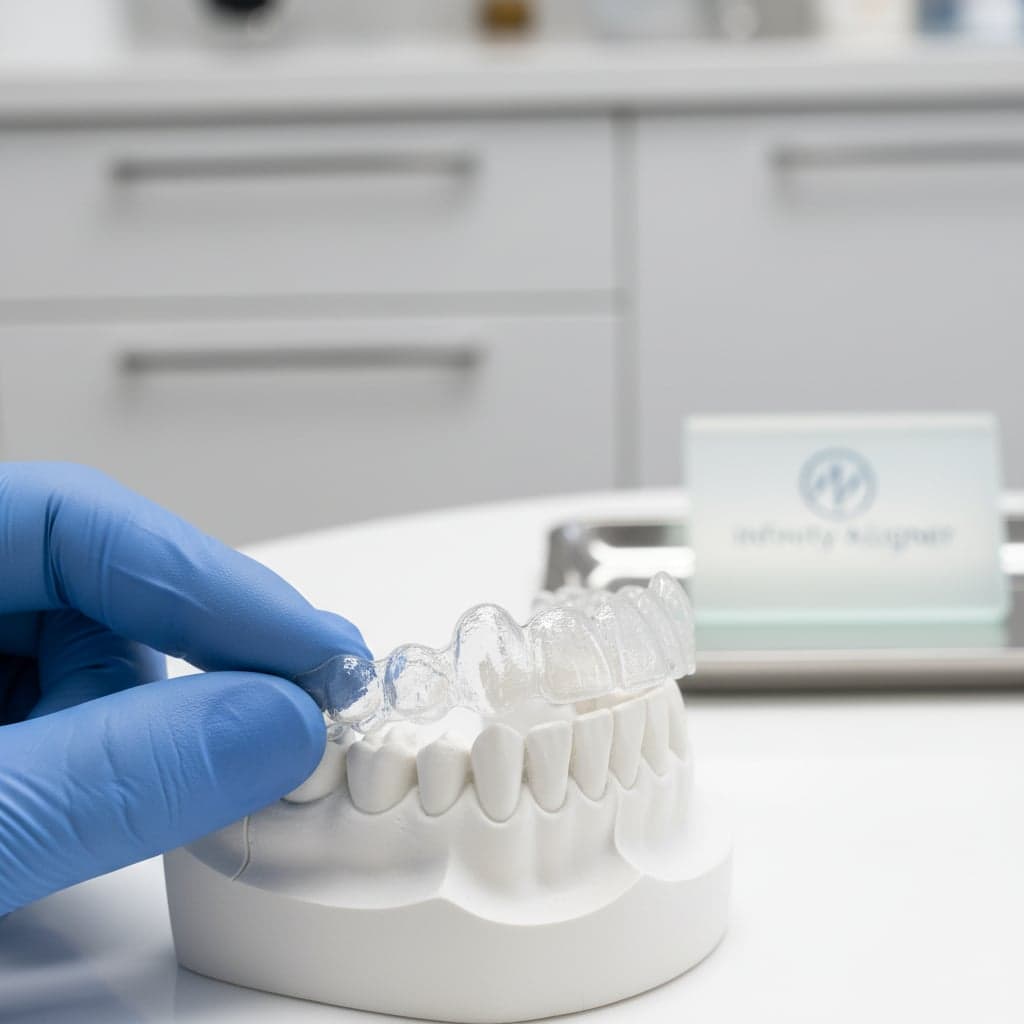
CAD/CAM digital workflow in orthodontics: from intraoral scanning to aligner fabrication
Deformation, shrinkage and cumulative errors: why the conventional impression chain compromises aligner precision
Intraoral Scanners 2025: Complete Technical and Metrological Comparison
Why Choose Infinity Aligner? The Complete Guide for Dental Practitioners
Composite Selection for Aligner Attachments: Mechanical Analysis and Clinical Protocol
TMJ and Malocclusion: Differential Diagnosis and Clinical Approach for the Practitioner
Travelling with Clear Aligners: The Complete Guide for Stress-Free Trips

The First Month with Aligners: What to Expect Week by Week
Pre-Prosthetic Orthodontics: Preparing the Site Before Implants or Veneers

How to Present Aligners to a Hesitant Patient — A Consultation Script

Anterior Open Bite and Aligners: Protocol, Intrusion and Relapse Risk
Posterior & Anterior Crossbite: Diagnosis and Correction with Clear Aligners
Invisalign vs Infinity Aligner: Complete Price Comparison in Tunisia (2026)
What Happens If You Don't Wear Your Aligners 22 Hours a Day?

Myths and Misconceptions About Clear Aligners: What Patients and Dentists Get Wrong

Sleep Apnea and Orthodontics: The Dentist's Role in Screening and Management

Clear Aligners Before a Wedding: How Many Months Should You Plan?

Ramadan and Clear Aligners: A Guide to Wearing Them While Fasting
Consult a certified dentist
Our 200+ certified partners in Tunis, Sfax, Sousse and the francophone zone welcome you.
Book a consultation