How Long Does Clear Aligner Treatment Take?

Average duration of clear aligner treatment: factors that influence treatment time, key stages and tips to stay on track.
It's one of the first questions asked during an orthodontic consultation: how long will I wear clear aligners? The answer varies from patient to patient, but this guide gives you all the keys to estimating your treatment duration.
Average durations by case complexity
| Correction type | Number of aligners | Estimated duration |
|---|---|---|
| Mild (gap, slight crowding) | 5 to 14 | 2 to 5 months |
| Moderate (crowding, rotation) | 15 to 30 | 6 to 12 months |
| Full (malocclusion, open bite) | 30 to 50+ | 12 to 20 months |
The 4 factors that determine duration
- Clinical complexity: major rotations, extrusions and inclinations lengthen treatment
- Wear compliance: aligners must be worn 20 to 22 hours per day without exception
- Aligner change frequency: every 7 to 14 days as set by your practitioner
- Biological response: some people move their teeth faster than others
The key role of 3D simulation
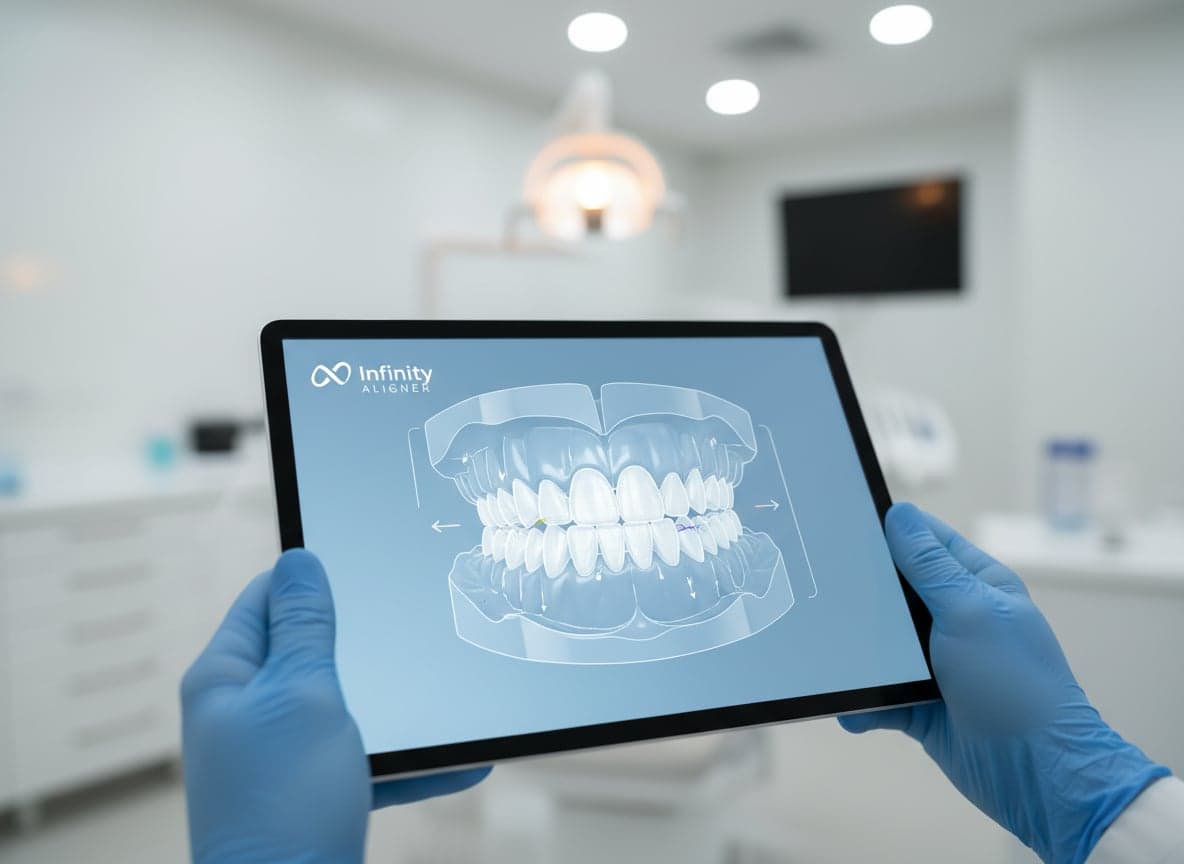
Before starting your treatment, your certified Infinity Aligner dentist will show you a 3D simulation indicating the exact number of planned aligners and the theoretical treatment duration. This simulation is a precise roadmap — not a vague estimate. It allows you to know your final result before even wearing the first aligner.
Refinements: what are they?
Sometimes additional aligners — called "refinements" — are needed at the end of treatment to fine-tune certain movements. These refinements are included in the Infinity Aligner package and do not change the overall cost. They extend treatment by 4 to 12 weeks depending on the case.
Retention phase: essential after treatment
Once active treatment is complete, a retention phase is mandatory to stabilise results. It involves wearing a retainer tray at night for a minimum of 6 to 12 months. Neglecting this phase is the leading cause of orthodontic relapse — your teeth can return to their original position without wearing the retainer.
Tips to avoid lengthening your treatment
- Wear your aligners at least 22 hours per day, including at night
- Never miss a follow-up appointment with your dentist
- Switch to a new aligner in the evening (less discomfort during the day)
- Report any broken or lost aligner immediately
- Use chewies to properly seat each aligner
Conclusion
The duration of clear aligner treatment depends above all on your clinical case and your discipline. On average, plan for 6 to 14 months for most adult patients. The best way to get an accurate estimate is a consultation with a certified Infinity Aligner dentist, who will establish your personalised treatment plan with a 3D simulation.
Infinity Aligner
Clinical & editorial team
More articles

How to Choose Clear Aligners in Tunisia

Clear Aligners vs Braces: Complete Comparison

How Much Do Clear Aligners Cost in Tunisia?

How to Clean and Care for Your Clear Aligners Daily

Clear Aligners for Teenagers: What Parents Need to Know
Gap Teeth & Diastema: Can Clear Aligners Fix Them?
Can You Play Sports with Clear Aligners?

3D Smile Simulation: How It Works and What to Expect

Orthodontic Relapse: Why Teeth Move After Treatment
Intraoral Scanner vs Traditional Impressions: What's the Difference?

Clear Aligners for Adults: Is It Ever Too Late?
Wisdom Teeth and Clear Aligners: Are They Compatible?

Clear Aligners: A Versatile Therapeutic Approach in Orthodontics

Orthodontics and Periodontal Health: What Every Patient Needs to Know
The Technology Behind Clear Aligners: From Design to Tray

How to Prepare for Your Orthodontic Consultation: 10 Questions to Ask
Bruxism and Clear Aligners: Can You Correct and Protect at the Same Time?

Class II Malocclusion and Clear Aligners: What Treatment Options Exist?
Clear Aligners and Dental Implants: Protocol, Timing and Clinical Cases

Digital Workflow and Aligner Biomechanics: The Advanced Practitioner Protocol

The Limits of Clear Aligners: Identifying Complex Cases Beyond Their Reach
Aligner Manufacturing: Thermoforming, 3D Printing and Polymer Science
Invisible Orthodontics in 2030: Predictive AI, Direct Printing and Active Materials

Smile Without Borders: The Price of Aligners Between Tunisia, Europe and Canada

Attachments in Invisible Orthodontics: The Silent Levers of Biomechanics

The Smile Beyond the Mirror: The Profound Impact of Dental Alignment on Psychological Well-being

Tunisia: The New Eldorado of Digital Dentistry and Medical Tourism
Post-Orthodontic Retention: The Forgotten Step That Decides Everything
What You Can (and Cannot) Eat With Clear Aligners
Teeth Whitening and Clear Aligners: Can You Treat and Whiten at the Same Time?
TMJ and Clear Aligners: How Invisible Orthodontics Acts on Jaw Pain
The Different Types of Dental Retainer: A Complete Guide After Orthodontic Treatment
The hidden dangers of metal braces: what patients need to know
Root resorption: the silent risk of poorly managed orthodontic treatments

Orthodontics and cavities: how metal braces compromise dental hygiene

Orthodontic relapse: why teeth return to their original position

Braces and chronic pain: the underestimated impact on daily quality of life
Intraoral scanner vs conventional impressions: dimensional analysis and clinical implications
CAD/CAM digital workflow in orthodontics: from intraoral scanning to aligner fabrication
Deformation, shrinkage and cumulative errors: why the conventional impression chain compromises aligner precision
Intraoral Scanners 2025: Complete Technical and Metrological Comparison
Why Choose Infinity Aligner? The Complete Guide for Dental Practitioners
Composite Selection for Aligner Attachments: Mechanical Analysis and Clinical Protocol
TMJ and Malocclusion: Differential Diagnosis and Clinical Approach for the Practitioner
Travelling with Clear Aligners: The Complete Guide for Stress-Free Trips

The First Month with Aligners: What to Expect Week by Week
Pre-Prosthetic Orthodontics: Preparing the Site Before Implants or Veneers
How to Present Aligners to a Hesitant Patient — A Consultation Script
Anterior Open Bite and Aligners: Protocol, Intrusion and Relapse Risk
Posterior & Anterior Crossbite: Diagnosis and Correction with Clear Aligners
Tobacco, Cigarettes and Clear Aligners: Everything You Need to Know
Invisalign vs Infinity Aligner: Complete Price Comparison in Tunisia (2026)
What Happens If You Don't Wear Your Aligners 22 Hours a Day?
Myths and Misconceptions About Clear Aligners: What Patients and Dentists Get Wrong

Sleep Apnea and Orthodontics: The Dentist's Role in Screening and Management
Consult a certified dentist
Our 200+ certified partners in Tunis, Sfax, Sousse and the francophone zone welcome you.
Book a consultation