Sleep Apnea and Orthodontics: The Dentist's Role in Screening and Management

Snoring, night wakings, chronic fatigue: obstructive sleep apnea often has an anatomical origin the dentist is best placed to spot. Screening, mandibular advancement devices, and the real place of clear aligners.
A patient who grinds their teeth at night, whose tongue shows the scalloped imprints of chronic pressure against the arches, or whose palate is unusually narrow — these are signs a dentist observes routinely, often well before any medical diagnosis is made. What many practitioners still overlook: these markers are frequently associated with obstructive sleep apnea syndrome (OSA), a breathing disorder affecting roughly 13% of adult men and 6% of adult women according to major epidemiological cohorts, and one that remains widely underdiagnosed. The dental chair, through the frequency of visits and direct access to oro-pharyngeal anatomy, occupies a strategic position in this screening process — a role still too rarely formalized in everyday practice.
1. What Is Obstructive Sleep Apnea?
OSA is characterized by repeated episodes of partial or complete upper airway obstruction during sleep, causing micro-arousals and fragmented deep sleep. Severity is measured by the Apnea-Hypopnea Index (AHI), the number of abnormal respiratory events per hour of sleep: mild between 5 and 15, moderate between 15 and 30, severe above 30. Formal diagnosis relies on polysomnography or a home sleep study performed by a sleep physician — never by the dentist, whose role is limited to spotting warning signs and referring the patient onward.
- Loud, regular snoring, often reported by a partner
- Observed breathing pauses during sleep
- Excessive daytime sleepiness despite adequate sleep duration
- Nighttime awakenings with a choking sensation
- Morning headaches and dry mouth on waking
- Daytime concentration difficulties and irritability
- Frequent association with hypertension and cardiovascular disorders
2. Why the Dentist Is Often the First to Spot the Signs
A patient sees their dentist on average once or twice a year, compared to much rarer and often delayed access to a sleep physician. A routine intraoral exam reveals several anatomical markers statistically associated with elevated OSA risk, independent of any complaint the patient makes about their sleep.
- Scalloped tongue — dental imprints along the lateral borders, a sign of chronic tongue thrust against a restricted space
- High Mallampati score (class III or IV) — reduced visibility of the soft palate and uvula on mouth opening, correlated with a narrow pharyngeal space
- Narrow, high-arched palate — insufficient transverse maxillary development, often a legacy of childhood mouth breathing
- Tooth wear suggestive of bruxism — nighttime bruxism is significantly more common in apneic patients, likely as a reflex mechanism to reopen the airway
- Visible mandibular retrognathia in profile — a set-back jaw reducing retro-lingual space
- Enlarged tonsils or macroglossia relative to available space
3. The Anatomical Link Between Malocclusion and Airway Space
Mandibular Retrognathia and Skeletal Class II
A mandible set back relative to the maxilla (skeletal Class II) mechanically pulls the tongue base backward, reducing the posterior pharyngeal space. During sleep, the loss of muscle tone accentuates this narrowing, favoring soft-tissue collapse. This is precisely the mechanism mandibular advancement devices target: by pushing the jaw forward, they artificially widen this space.
Narrow Palate, Mouth Breathing and Development in Children
In children, chronic mouth breathing — often linked to enlarged adenoids or tonsils, or untreated respiratory allergies — alters tongue posture and prevents normal transverse palatal development that the tongue would otherwise drive. The result is a narrow, high-arched palate, which also reduces the volume of the nasal cavities directly above it. This causal chain explains why some professional bodies recommend early orthodontic screening, between ages 6 and 10, in cases of persistent mouth breathing — not to treat an already-established apnea, but to limit the development of anatomical risk factors into adulthood.
4. Mandibular Advancement Devices (MADs): The Reference Dental Treatment
For mild to moderate OSA, or in cases of CPAP intolerance, the mandibular advancement device is the dental treatment recognized by international guidelines. This custom-made device, fabricated from impressions or an intraoral scan, holds the mandible in a forward position during sleep, mechanically clearing the retro-lingual space. Its prescription and follow-up depend on structured collaboration between the sleep physician, who establishes the indication after polysomnography, and a dentist specifically trained in dental sleep medicine, who designs, adjusts, and monitors the device and its long-term impact on occlusion.
| Criterion | Mandibular Advancement Device | CPAP |
|---|---|---|
| Primary indication | Mild to moderate OSA, isolated snoring | Moderate to severe OSA |
| Effect on AHI | Significant reduction, variable by anatomy | Largest reduction, gold standard |
| Reported compliance | Generally better (discreet, portable device) | Often limited by mask discomfort |
| Main side effects | Progressive occlusal changes, initial hypersalivation | Nasal dryness, skin irritation, partner disturbance |
| Required follow-up | Regular dental and occlusal monitoring | Pulmonology follow-up and pressure titration |
5. Clear Aligners and Sleep Apnea: What You Actually Need to Know
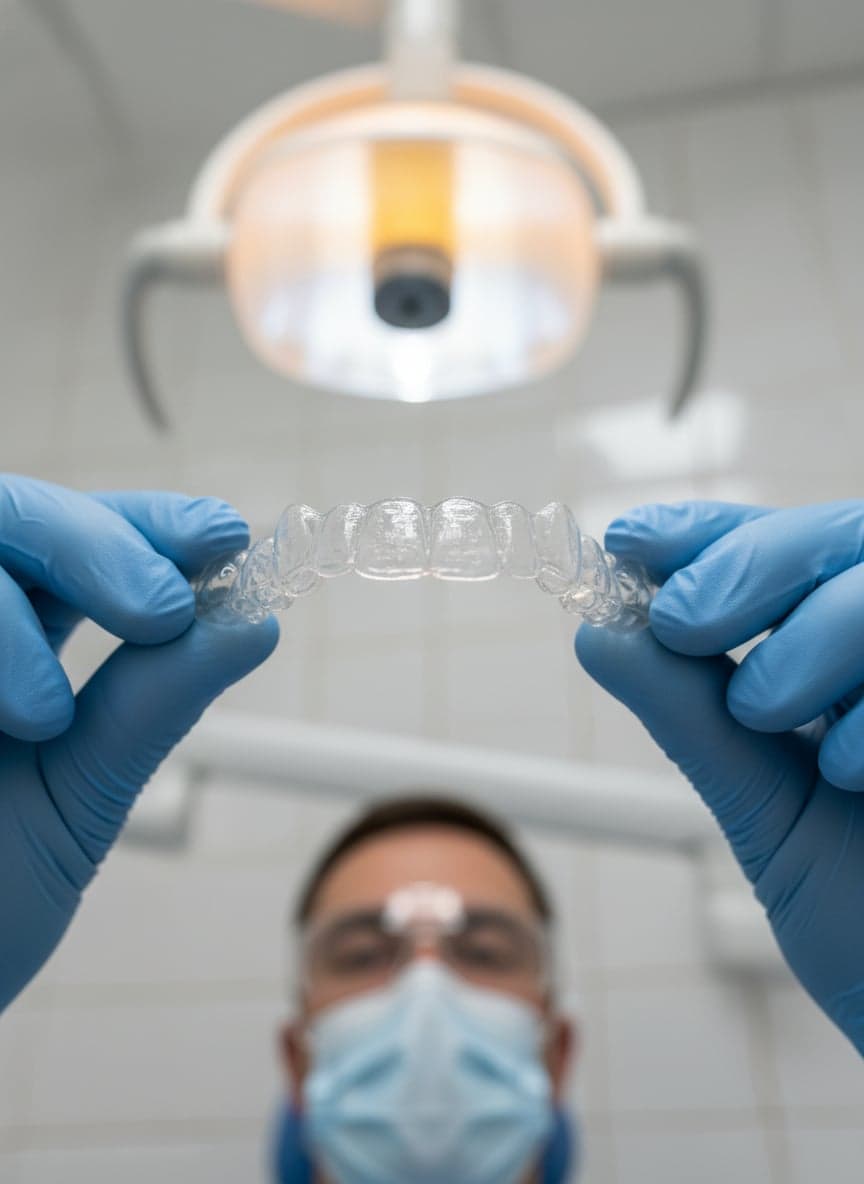
It's worth clearing up a common confusion, sometimes fueled by imprecise marketing: a clear aligner is not a mandibular advancement device and does not constitute a treatment for adult sleep apnea. Aligners move teeth within the arch; they don't propel the jaw forward or directly widen the pharyngeal space the way a device specifically designed for that purpose does. That said, a well-planned orthodontic treatment can have an indirect, preventive effect on anatomical risk factors — particularly in a young patient still growing.
Arch Expansion in Children: A Well-Documented Preventive Role
In a growing child, palatal expansion — orthodontic or via a rapid expansion device — widens the maxilla and, through anatomical spillover, increases nasal cavity volume and improves upper airway patency. Several pediatric studies report reduced AHI in children treated with palatal expansion for malocclusion associated with mouth breathing. It's in this early context — well before clear aligners are typically indicated, which are mostly reserved for the established adult or adolescent dentition — that orthodontics plays its most well-documented preventive role.
What Aligners Don't Treat
- They never replace an MAD or CPAP in an adult diagnosed with moderate to severe OSA
- They provide no diagnosis whatsoever — only physician-prescribed polysomnography can confirm OSA
- Purely cosmetic tooth movement, without any change to jaw position or pharyngeal space, has no demonstrated effect on adult nighttime breathing
- Any commercial claim directly linking aligners to curing sleep apnea should be treated with the utmost caution
6. The Screening and Diagnosis Pathway
Faced with suggestive signs, a dentist can use validated screening questionnaires — the STOP-BANG score or the Epworth Sleepiness Scale — to objectify a level of suspicion before referring the patient onward. This screening never replaces a medical diagnosis: it only serves to prompt a consultation with a sleep physician or pulmonologist, who will decide whether polysomnography is warranted. Once a diagnosis is made, a dentist trained in dental sleep medicine can join the care chain to design and monitor a mandibular advancement device, in ongoing coordination with the prescribing physician.
7. Warning Signs During a Dental Visit
- Generalized tooth wear unexplained by other factors
- Scalloped tongue noted on examination
- Narrow, high-arched palate in an adult or child
- Marked mandibular retrognathia visible in profile
- Patient reporting significant daytime fatigue or known snoring
- History of resistant hypertension or cardiac arrhythmia
- Increased neck circumference, often associated with elevated BMI
Conclusion
The dentist is neither a pulmonologist nor a sleep physician, but their privileged vantage point on oro-pharyngeal anatomy makes them a valuable, often underused screening resource. Spotting the signs, referring for a formal medical diagnosis, and — once that diagnosis is made — designing or monitoring an appropriate mandibular advancement device: this is the realistic and rigorous scope of dental involvement in OSA management. Clear aligners remain a treatment for occlusion and smile aesthetics; in children, well-indicated arch expansion can have a genuine preventive effect on airway development, but that effect must never be confused with a treatment for adult sleep apnea. Infinity Aligner network dentists are trained to recognize these warning signs and refer patients to the appropriate care pathway — always alongside, never in place of, proper medical sleep care.
Infinity Aligner
Clinical & editorial team
More articles

How to Choose Clear Aligners in Tunisia

Clear Aligners vs Braces: Complete Comparison

How Much Do Clear Aligners Cost in Tunisia?
How Long Does Clear Aligner Treatment Take?

How to Clean and Care for Your Clear Aligners Daily

Clear Aligners for Teenagers: What Parents Need to Know
Gap Teeth & Diastema: Can Clear Aligners Fix Them?
Can You Play Sports with Clear Aligners?

3D Smile Simulation: How It Works and What to Expect

Orthodontic Relapse: Why Teeth Move After Treatment
Intraoral Scanner vs Traditional Impressions: What's the Difference?

Clear Aligners for Adults: Is It Ever Too Late?
Wisdom Teeth and Clear Aligners: Are They Compatible?

Clear Aligners: A Versatile Therapeutic Approach in Orthodontics

Orthodontics and Periodontal Health: What Every Patient Needs to Know
The Technology Behind Clear Aligners: From Design to Tray

How to Prepare for Your Orthodontic Consultation: 10 Questions to Ask
Bruxism and Clear Aligners: Can You Correct and Protect at the Same Time?

Class II Malocclusion and Clear Aligners: What Treatment Options Exist?
Clear Aligners and Dental Implants: Protocol, Timing and Clinical Cases

Digital Workflow and Aligner Biomechanics: The Advanced Practitioner Protocol

The Limits of Clear Aligners: Identifying Complex Cases Beyond Their Reach
Aligner Manufacturing: Thermoforming, 3D Printing and Polymer Science
Invisible Orthodontics in 2030: Predictive AI, Direct Printing and Active Materials

Smile Without Borders: The Price of Aligners Between Tunisia, Europe and Canada

Attachments in Invisible Orthodontics: The Silent Levers of Biomechanics

The Smile Beyond the Mirror: The Profound Impact of Dental Alignment on Psychological Well-being

Tunisia: The New Eldorado of Digital Dentistry and Medical Tourism
Post-Orthodontic Retention: The Forgotten Step That Decides Everything
What You Can (and Cannot) Eat With Clear Aligners

Teeth Whitening and Clear Aligners: Can You Treat and Whiten at the Same Time?

TMJ and Clear Aligners: How Invisible Orthodontics Acts on Jaw Pain
The Different Types of Dental Retainer: A Complete Guide After Orthodontic Treatment
The hidden dangers of metal braces: what patients need to know
Root resorption: the silent risk of poorly managed orthodontic treatments

Orthodontics and cavities: how metal braces compromise dental hygiene

Orthodontic relapse: why teeth return to their original position

Braces and chronic pain: the underestimated impact on daily quality of life
Intraoral scanner vs conventional impressions: dimensional analysis and clinical implications
CAD/CAM digital workflow in orthodontics: from intraoral scanning to aligner fabrication
Deformation, shrinkage and cumulative errors: why the conventional impression chain compromises aligner precision
Intraoral Scanners 2025: Complete Technical and Metrological Comparison
Why Choose Infinity Aligner? The Complete Guide for Dental Practitioners
Composite Selection for Aligner Attachments: Mechanical Analysis and Clinical Protocol
TMJ and Malocclusion: Differential Diagnosis and Clinical Approach for the Practitioner
Travelling with Clear Aligners: The Complete Guide for Stress-Free Trips

The First Month with Aligners: What to Expect Week by Week
Pre-Prosthetic Orthodontics: Preparing the Site Before Implants or Veneers
How to Present Aligners to a Hesitant Patient — A Consultation Script
Anterior Open Bite and Aligners: Protocol, Intrusion and Relapse Risk
Posterior & Anterior Crossbite: Diagnosis and Correction with Clear Aligners
Tobacco, Cigarettes and Clear Aligners: Everything You Need to Know
Invisalign vs Infinity Aligner: Complete Price Comparison in Tunisia (2026)
What Happens If You Don't Wear Your Aligners 22 Hours a Day?
Myths and Misconceptions About Clear Aligners: What Patients and Dentists Get Wrong
Consult a certified dentist
Our 200+ certified partners in Tunis, Sfax, Sousse and the francophone zone welcome you.
Book a consultation