CAD/CAM digital workflow in orthodontics: from intraoral scanning to aligner fabrication
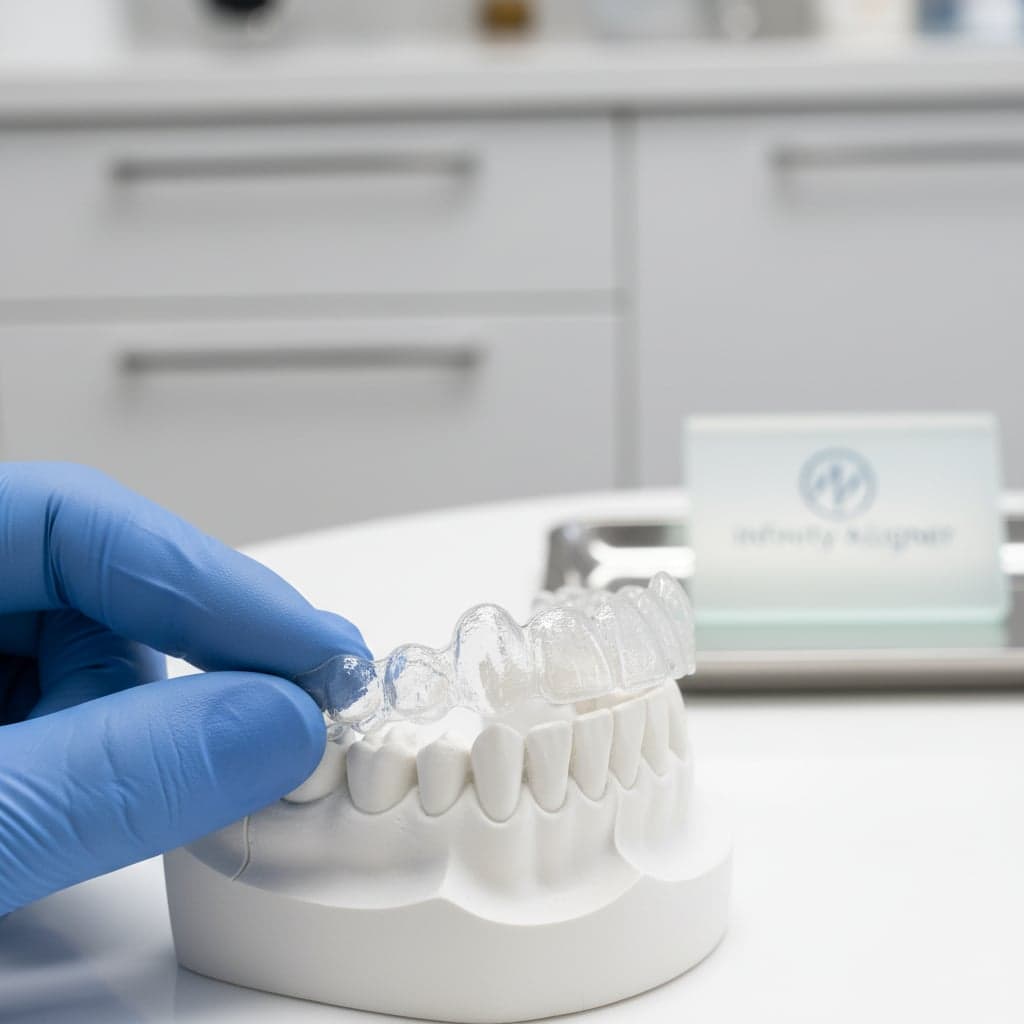
Scan protocols, STL/OBJ/3MF file formats, stitching algorithms, 3D simulation, thermoforming and 3D printing: complete mastery of the digital workflow for certified aligner production.
The production of a precision clear aligner involves a continuous digital chain, from capturing dental morphology to delivering the final tray. Each link in this chain introduces technical parameters that condition the quality of the finished product. This article describes and analyses the entirety of this workflow for practitioners and dental professionals involved in the prescription and fabrication of aligners.
1. Intraoral scanning protocols: optimising acquisition
Scan quality does not depend solely on hardware — the operational protocol is decisive. For a complete orthodontic scan (maxillary + mandibular arch + occlusion), recommended best practices are:
- Occlusal-lingual-buccal (OLB) scanning sequence: begin with occlusal surfaces that provide the maximum geometric references for the stitching algorithm, then complete with lingual and buccal faces.
- Probe movement speed: 5 to 15 mm/s depending on the system. Too fast generates under-coverage zones; too slow creates redundant data that burdens processing.
- Overlap between segments: 20 to 30% superposition between each consecutive image is required for the ICP (Iterative Closest Point) to converge correctly.
- Moisture management: saliva and gingival bleeding create surface artefacts by absorbing or reflecting light unpredictably. Moisture control by relative isolation (cotton rolls, suction) is essential in critical areas.
- Probe temperature: modern systems integrate anti-fog preheating. On systems without preheating, a 20–30 second warm-up time in the mouth is recommended before capture.
2. Stitching algorithms and surface reconstruction
Stitching (segment assembly) is the most critical operation in the digital pipeline. It consists of aligning and merging the partial point clouds acquired during different probe passes to form a coherent surface mesh. The algorithms used are variants of ICP (Iterative Closest Point), sometimes augmented with deep learning techniques to improve robustness on poorly differentiated biological surfaces.
Stitching errors — called "drifts" — manifest as a progressive arc- or spiral-shaped deformation of the model, proportional to the length of the scanned arch. These errors are particularly problematic on long arches or in the presence of large flat surfaces (edentulous areas, adjacent single crowns without relief). Modern scanners use fixed anatomical landmarks (tuberosities, retromolar pad) to "anchor" the model and reduce drift to less than 30 µm on a complete arch.
3. File formats and interoperability
The output of an intraoral scanner is a 3D polygonal mesh stored in different formats depending on the systems and uses:
| Format | Type | Mesh resolution | Orthodontic use | Interoperability |
|---|---|---|---|---|
| STL (STereoLithography) | Triangular mesh, surfaces only | 0.01–0.05 mm depending on export | Universal fabrication standard | Universal |
| OBJ (Wavefront) | Mesh + textures + normals | Variable | Visualisation, sharing | Good |
| PLY (Polygon File Format) | Mesh + custom attributes (colour, quality) | Variable | Archiving, research | Medium |
| 3MF (3D Manufacturing Format) | Structured XML container, multi-material | High precision | Multi-material 3D printing | Growing |
| DCM/DICOM | 3D volume (voxels), from CBCT | Depends on CBCT (0.1–0.4 mm) | Superimposition with surface scan | Specialised |
STL remains the de facto standard for fabrication (thermoforming, 3D printing), but stores no colour, texture or surface attribution information (tooth identification). Proprietary manufacturer formats (TRIOS = .3OXZ, iTero = modified .3DS, CEREC = .cdt) encapsulate additional metadata (tooth number, colour, scan quality) but require conversion for open workflows.
4. 3D orthodontic planning software
The simulation of orthodontic treatment on the digital model involves a dedicated software chain. Key functions of 3D orthodontic planning software include:
- Automatic tooth segmentation: identification and separation of each dental unit in the global mesh. Deep learning algorithms today achieve automatic segmentation accuracy > 95% on molars, and > 98% on incisors, with residual manual correction for tight contacts.
- Virtual articulator: simulation of intermaxillary relationships (MIP, CR, functional movements) based on occlusion scan data. The precision of the occlusal record remains a critical point: a virtual face bow can reduce mounting error to less than 0.5°.
- Movement programming: 6 degrees-of-freedom manipulation interface (translation and rotation along x, y, z) for each tooth, with control of parametric parameters (tip, torque, in-out) referenced to the occlusal plane.
- Staging calculation: movement sequencing algorithms that divide the total trajectory into stages (staging) of 0.1 to 0.25 mm per aligner depending on movement complexity. Staging rules condition the number of trays and treatment duration.
- Collision verification: automatic control of inter-stage occlusal interferences to prevent unplanned premature contacts during treatment.
5. Digital fabrication: thermoforming vs direct 3D printing
Once the simulation is approved, two fabrication pathways exist for physical aligner production:
| Parameter | Thermoforming on printed model | Direct 3D printing (SLA/DLP) |
|---|---|---|
| Final dimensional precision | ± 100–200 µm (cumulative model + thermoforming error) | ± 50–80 µm (depending on printer resolution and resin) |
| Material | PET-G, TPU, Zendura (polyurethane) | Orthodontic photopolymerisable resins (FDA Class II) |
| Controllable thickness | Yes (0.5 to 1.5 mm depending on sheet) | Yes (parametric design) |
| Optical transparency | Excellent (thermo-drawn materials) | Variable by resin (slightly less transparent) |
| Production scalability | High (multi-part thermoforming) | Very high (batch printing, N simultaneous parts) |
| Unit cost | Low (€0.5–2/tray) | Medium (€2–5/tray depending on resin) |
Thermoforming on SLA or DLP printed models remains the dominant technique in large-scale aligner production. Direct 3D printing of the aligner is developing rapidly but still faces challenges of long-term resin biocompatibility (oxidation, residual monomer release) and slightly inferior optical transparency compared to extruded thermoplastic films.
6. Digital quality control at each stage
A rigorous digital workflow integrates formalised quality control checkpoints at each transition between stages:
- Post-scan: automatic assessment of surface coverage (% of areas with missing data), drift verification by arch curvature analysis.
- Post-segmentation: control of inter-dental separation margins, verification of anatomical coherence of tooth axes.
- Post-planning: verification of movement amplitudes against biological limits (max 1.5 mm displacement per series, max 5° torque per stage), disclusion space control.
- Post-model printing: metrology by reference scan (comparison of planned vs printed model, tolerance ± 50 µm).
- Post-thermoforming: thickness control by ultrasonic micrometer (target: deviation < 0.1 mm from specification), fit test on reference model.
Conclusion
Mastering the CAD/CAM digital workflow in orthodontics requires a thorough understanding of each link in the chain, from optical acquisition to physical fabrication. Practitioners who integrate these parameters into their practice — and who select their manufacturing partners accordingly — achieve significantly more predictable and reproducible orthodontic outcomes than those who delegate this expertise without a formalised quality framework.
Infinity Aligner
Clinical & editorial team
More articles
How to Choose Clear Aligners in Tunisia
Clear Aligners vs Braces: Complete Comparison
How Much Do Clear Aligners Cost in Tunisia?
How Long Does Clear Aligner Treatment Take?
How to Clean and Care for Your Clear Aligners Daily
Clear Aligners for Teenagers: What Parents Need to Know
Gap Teeth & Diastema: Can Clear Aligners Fix Them?
Can You Play Sports with Clear Aligners?

3D Smile Simulation: How It Works and What to Expect
Orthodontic Relapse: Why Teeth Move After Treatment
Intraoral Scanner vs Traditional Impressions: What's the Difference?
Clear Aligners for Adults: Is It Ever Too Late?
Wisdom Teeth and Clear Aligners: Are They Compatible?

Clear Aligners: A Versatile Therapeutic Approach in Orthodontics
Orthodontics and Periodontal Health: What Every Patient Needs to Know
The Technology Behind Clear Aligners: From Design to Tray
How to Prepare for Your Orthodontic Consultation: 10 Questions to Ask
Bruxism and Clear Aligners: Can You Correct and Protect at the Same Time?
Class II Malocclusion and Clear Aligners: What Treatment Options Exist?
Clear Aligners and Dental Implants: Protocol, Timing and Clinical Cases
Digital Workflow and Aligner Biomechanics: The Advanced Practitioner Protocol
The Limits of Clear Aligners: Identifying Complex Cases Beyond Their Reach
Aligner Manufacturing: Thermoforming, 3D Printing and Polymer Science
Invisible Orthodontics in 2030: Predictive AI, Direct Printing and Active Materials
Smile Without Borders: The Price of Aligners Between Tunisia, Europe and Canada
Attachments in Invisible Orthodontics: The Silent Levers of Biomechanics

The Smile Beyond the Mirror: The Profound Impact of Dental Alignment on Psychological Well-being
Tunisia: The New Eldorado of Digital Dentistry and Medical Tourism
Post-Orthodontic Retention: The Forgotten Step That Decides Everything
What You Can (and Cannot) Eat With Clear Aligners
Teeth Whitening and Clear Aligners: Can You Treat and Whiten at the Same Time?
TMJ and Clear Aligners: How Invisible Orthodontics Acts on Jaw Pain
The Different Types of Dental Retainer: A Complete Guide After Orthodontic Treatment
The hidden dangers of metal braces: what patients need to know
Root resorption: the silent risk of poorly managed orthodontic treatments

Orthodontics and cavities: how metal braces compromise dental hygiene
Orthodontic relapse: why teeth return to their original position
Braces and chronic pain: the underestimated impact on daily quality of life
Intraoral scanner vs conventional impressions: dimensional analysis and clinical implications
Deformation, shrinkage and cumulative errors: why the conventional impression chain compromises aligner precision
Intraoral Scanners 2025: Complete Technical and Metrological Comparison
Why Choose Infinity Aligner? The Complete Guide for Dental Practitioners
Composite Selection for Aligner Attachments: Mechanical Analysis and Clinical Protocol
TMJ and Malocclusion: Differential Diagnosis and Clinical Approach for the Practitioner
Travelling with Clear Aligners: The Complete Guide for Stress-Free Trips
The First Month with Aligners: What to Expect Week by Week
Pre-Prosthetic Orthodontics: Preparing the Site Before Implants or Veneers
How to Present Aligners to a Hesitant Patient — A Consultation Script
Anterior Open Bite and Aligners: Protocol, Intrusion and Relapse Risk
Posterior & Anterior Crossbite: Diagnosis and Correction with Clear Aligners
Tobacco, Cigarettes and Clear Aligners: Everything You Need to Know
Invisalign vs Infinity Aligner: Complete Price Comparison in Tunisia (2026)
What Happens If You Don't Wear Your Aligners 22 Hours a Day?
Myths and Misconceptions About Clear Aligners: What Patients and Dentists Get Wrong
Sleep Apnea and Orthodontics: The Dentist's Role in Screening and Management
Consult a certified dentist
Our 200+ certified partners in Tunis, Sfax, Sousse and the francophone zone welcome you.
Book a consultation